Shelf, Mirror, Socket: A Bacup Dressing Table Built Into the Wardrobe
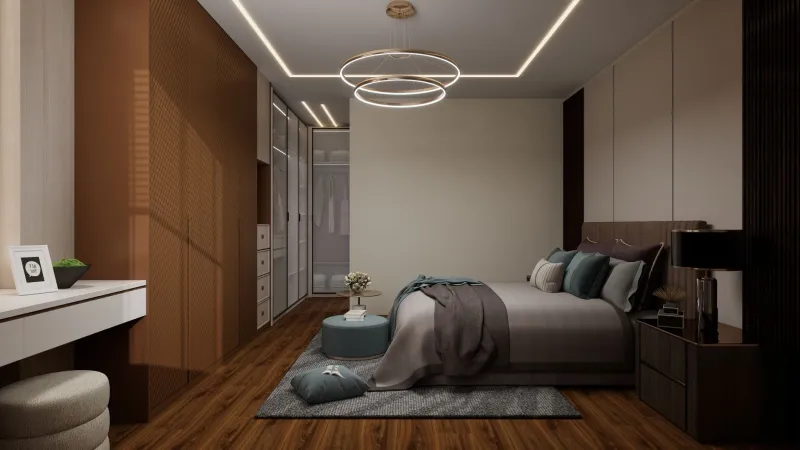
A dressing table often begins as a good intention: a proper place to sit, a mirror at the right height, drawers that keep the small things together. In practice, plenty of Bacup bedrooms end up with a narrow shelf under a window, a stool that lives in the way and a tangle of hairbands in a cereal bowl. If the storage is being fitted anyway, it makes sense to give the dressing area a proper job description.
Start with the seat, not the mirror
The usual mistake is to design the mirror first and squeeze the seating around it. Work the other way round. A usable dressing table needs a knee space roughly 60cm wide and at least 45cm deep, with a surface height around 72cm to 76cm for most adults. If the household is tall, nudge the top up towards 76cm; if it is a teenager's room, consider a slightly lower top or a chair with an adjustable seat.
The stool matters too. A seat height of about 44cm to 46cm suits a standard table, and it should tuck under the surface rather than sit proud into the room. In a compact Bacup bedroom, that tuck-in space is what stops the dressing table becoming an obstacle course between the bed and the wardrobe doors.
Integrate the table into the run, but not at the rail's expense
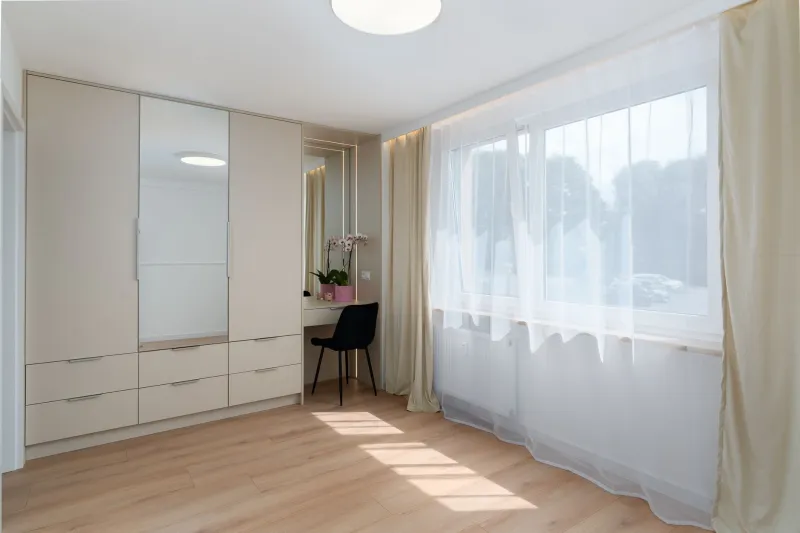
A dressing table can sit at the end of a wardrobe run, between two tall units, or in a lower bay beneath a window. Each has trade-offs. Between two wardrobes gives a neat, furniture-like look and hides clutter from the bed. At the end of a run, it is easier to fit a wider drawer stack and a decent mirror. Under a window, it gets daylight but can clash with curtains, radiators and deep sills.
What matters is that the dressing table does not eat into the hanging space you actually need. Keep at least 90cm to 100cm of clear rail for everyday clothes, and remember that a table unit usually needs 60cm to 80cm of width once the kneehole and side drawers are accounted for. In a small room, a shallow drawer stack beside the kneehole is often more useful than a deep bank of drawers under the surface.
Light from the front, not just overhead
A single ceiling light above a mirror is a poor friend to anyone putting on makeup or shaving. It casts shadows under the eyes and nose. The better arrangement is light from the front and sides, roughly at face height. Two small wall lights either side of the mirror, or a mirror with integrated LED strips, will do more than a brighter pendant in the middle of the room.
Where possible, place the mirror so it is not facing a bright window directly. A mirror opposite a window can bounce useful light into a dark Lancashire bedroom, but it can also create glare. A side-on position, or an angled mirror, usually gives a softer result. For older Bacup homes with low ceilings and modest windows, a slim mirror with a slim frame keeps the wall feeling uncluttered.
Drawers that understand cosmetics and cufflinks
A dressing table without drawer dividers becomes a shallow pit. Plan for one or two shallow drawers, around 60mm to 80mm deep, with movable dividers or felt inserts. That depth suits makeup, watches, hair clips and jewellery without everything sliding into one corner. A deeper drawer below can take a hairdryer, straighteners and the miscellaneous cables that come with them.
If the table is shared, divide the drawers vertically rather than by whim. One side for skincare, one for jewellery, one for the things that always go missing. A small pull-out tray at the back of the surface can hide chargers and plugs without making the top look like a workstation.
Power in an older Bacup bedroom
Adding a socket near a dressing table in a stone-built terrace or an older semi is rarely a matter of simply chasing a cable into the wall. Solid walls, lath and plaster, and years of previous alterations all need checking. Use a registered electrician, confirm the earthing and RCD protection, and decide whether the supply will come from an existing bedroom socket or a dedicated spur. In many cases, surface-mounted trunking painted to match the wall is less disruptive than deep chasing, especially where the wall is damp-prone or the plaster is fragile.
Put the socket above the table surface, not behind a drawer, and leave enough clearance for a plug and cable. If a mirror light is planned, get the wiring designed at the same time. It is far easier to run a supply before the fitted furniture goes in than to start lifting boards afterwards.
Keep the floor clear and the daylight moving
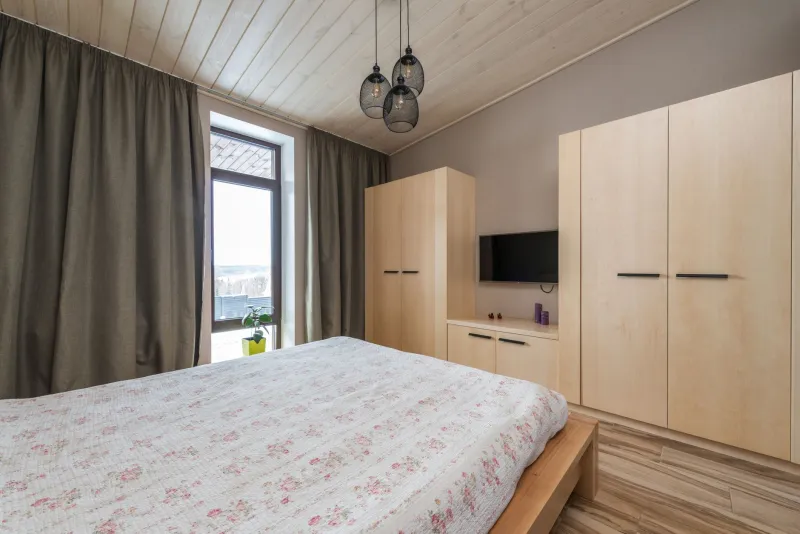
A dressing table should not block the main source of daylight or make the wardrobe doors awkward to open. In a small Bacup bedroom, a wall-mounted mirror above a shallow table is often better than a deep freestanding unit. If the table sits under a window, check curtain drop and radiator clearance before the order is signed off. A low-profile stool that slides fully underneath will make the room feel less crowded than a chair that lives at an angle.
Fitted storage works best when it supports the way the room is actually used. A dressing table is not a luxury add-on if it removes a chest of drawers, tidies the small stuff and gives someone a reason to sit down in the morning. Plan the seat, the light and the socket first, and the mirror will have somewhere sensible to hang.