Shelf Life: What Fitted Bedroom Storage Genuinely Does for a Bacup Asking Price
Ask ten people in Bacup whether fitted wardrobes pay for themselves and you'll get ten confident answers, most of them contradictory. One neighbour will swear the built-ins sold their house within a fortnight. Another will tell you they ripped theirs out the week they moved in. Both stories can be true, which is exactly why this is worth thinking about properly rather than trusting a slogan from a showroom brochure.
So let's look at it the way a seller actually would: money out, money back, and everything in between.
What buyers are actually scanning for
Estate agents will tell you, fairly consistently, that buyers make their mind up in the first few seconds of a room and then spend the rest of the viewing justifying that gut reaction. Storage rarely wins a sale on its own. What it does is remove friction — it lets a buyer picture their own life in the space without tripping over a drying rack or wondering where on earth the bedding goes.
In Bacup specifically, that matters because so much of the housing stock is compact. Stone-built terraces around the town centre and up towards Stacksteads often have decent floor area but awkward proportions: chimneys jutting into bedrooms, windows in the wrong place, a box room that's barely wider than a doorway. In that context, a well-planned run of fitted storage reads as solved. A buyer standing in a room where everything already has a home is a buyer who isn't mentally deducting two grand for 'sorting the storage out'.
What they tend not to do is pay a premium for it in the way sellers hope. Surveyors and mortgage valuers work from square footage, condition and comparables. Fitted furniture is generally treated as part of the fixtures, not as a separate line item that bumps the valuation. So the return, where it exists, arrives through desirability and speed of sale rather than through a formal uplift figure.
Crunching the rough numbers for 2026
Costs have settled a little after a wobbly few years, but they haven't gone backwards. For a typical Bacup double bedroom, expect something in the region of £1,400 to £2,600 for a straightforward run of fitted wardrobes with hinged or sliding doors in a mid-range board, and £3,000 upwards once you're into angled ceilings, alcove returns, internal drawers and lighting. A full box room conversion with a bed deck can push past £5,000 without trying very hard.
Against that, the honest arithmetic is this: fitted wardrobes rarely return their full cost at sale. The commonly quoted range in the trade is somewhere between 40% and 70% of outlay recovered, and even that is fuzzy because it depends on whether the buyer would have chosen that layout anyway. What you're really buying is a shorter time on the market and fewer price negotiations — and in a slow patch, that can be worth more than the percentage suggests.
There's also the entirely unscientific but very real benefit: you get to live with the storage for however many years you stay. A wardrobe that earns its keep every morning for a decade has already paid you back in a way a spreadsheet can't capture.
Configurations that tend to earn their keep
Some choices travel well. Others are a bet on your own taste being universal.
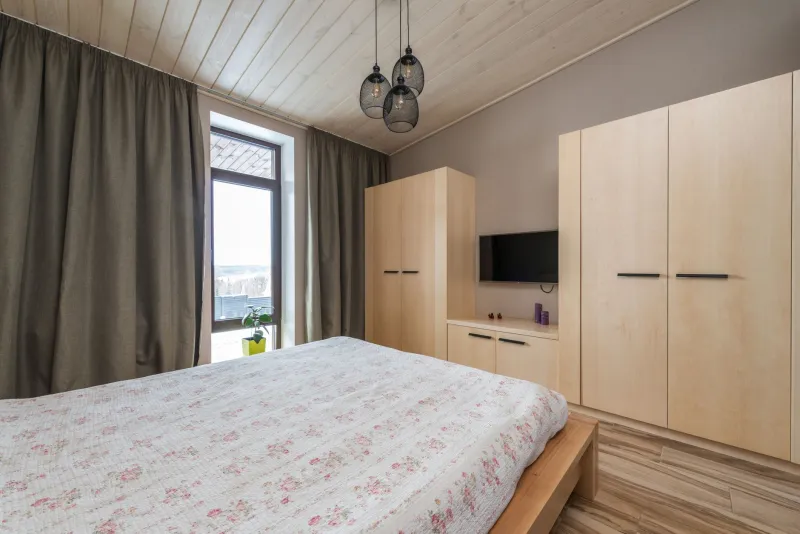
- Full-height runs with simple, flat doors. Ceiling-height storage in a neutral finish looks intentional rather than retrofitted, and the extra cubic metre at the top is where the suitcase and the Christmas boxes live. Buyers read it as generous, not as a design statement.
- Alcove units either side of a chimney breast. In the older terraces around Bacup, this is the classic move for a reason. It squares off a room that would otherwise have two dead corners and gives the bed a natural home.
- Sliding doors in tight rooms. Anything under about 2.6 metres of clear floor space benefits from doors that don't swing into the room. It's a small functional detail that photographs well too.
- A proper shallow unit in a landing or under-stair nook. Lancashire hallways are often long and narrow, and a 35cm-deep cupboard for coats and shoes does more for a viewing than a statement wardrobe ever will.
- Integrated drawers at waist height. A small thing, but buyers physically open drawers during viewings. Smooth runners and a lined interior quietly signal quality.
Where it can quietly cost you
Just as useful is knowing which choices can work against a sale — either by narrowing the pool of buyers or by asking them to budget for removal.
Heavy, dark, high-gloss finishes with ornate trim date fast, and they dominate a photograph in a way that makes small rooms look smaller. Over-fitted rooms are another risk: if the storage crowds the window, blocks a radiator or boxes in a chimney breast that a buyer would rather expose, you've traded character for cubic footage. In period homes around the Rossendale valley, that trade-off is noticed.
Then there's the practical stuff. Fitted furniture installed hard against an external stone wall without any allowance for airflow can trap condensation, and Lancashire's damp climate is unforgiving. A buyer's surveyor who spots black spotting behind a wardrobe will raise it, and suddenly your storage is a negotiating point in the wrong direction. Leaving a ventilated gap, sealing to the wall properly and not blocking airbricks matters more here than in drier parts of the country.
And a quiet one: badly proportioned units — a run that stops 30cm short of the ceiling, doors that don't align with the window reveal, awkward filler panels — make a room feel improvised. Buyers can't always articulate why a room feels off, but they feel it.
Period charm and storage can coexist
Older Bacup homes reward a light touch. If the room has a picture rail, a decent cornice or original four-panel doors, storage that sits below the rail and stops short of the detailing tends to sell better than a floor-to-ceiling bank that swallows everything. Where space is genuinely tight, the compromise is often a full-height run on the internal wall and a lower, furniture-style piece on the window side.
If you're weighing up a project, it's worth having the conversation with at least two local installers and asking each of them the same blunt question: what would you do if you were selling in three years? The answers tend to separate the ones thinking about resale from the ones thinking about a nice photo.
A sensible way to decide
Treat fitted wardrobes as a home improvement first and an investment second. Budget for a layout you'd be happy to live with for a decade, choose finishes that won't shout in 2032, and spend the money on the rooms where space is genuinely awkward — the box room, the alcove-heavy main bedroom, the hallway with nowhere to hang a coat. Do that, and the resale benefit tends to look after itself. Chase a headline return figure instead, and you'll probably end up disappointed in a way that has nothing to do with the quality of the work.