The Last 40 Centimetres: Do Bacup Wardrobes Need to Reach the Ceiling?
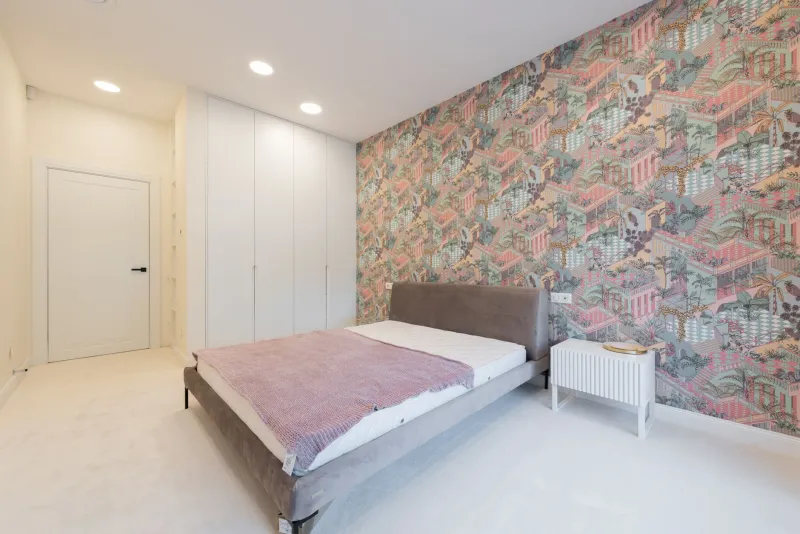
Walk into almost any bedroom in Bacup and you can spot the same argument happening in the space between the top of the wardrobe and the ceiling. Call it 40 centimetres, sometimes a bit more. It is either wasted air or the most useful storage in the house, and which one it turns out to be depends far less on the wardrobes than on how honestly you plan the top of them.
Full-height fitted furniture is one of those ideas that sounds like a straight upgrade. More cubic feet, a cleaner line, no dusty shelf to wipe. In practice, a ceiling-high run earns its keep in some rooms and quietly makes others feel like a shipping container. Here is how to tell which sort of room you have.
What a top box is genuinely good at
Think of the space above roughly 1.8 metres as a small, awkward loft that happens to be indoors. It suits things that are light, bulky and needed roughly twice a year: the spare duvet and its matching pillowcases, the Christmas tree and the box of baubles, suitcases, the travel cot, school-year memory boxes, ski gear nobody has used since 2019.
It is a poor home for anything heavy or anything you want on a Tuesday morning. Boxes of books, tools, kitchen overflow, weighty shoe collections and the ironing pile all belong lower down. So does anything you would need to fetch while half asleep.
A useful rule of thumb: if the item needs two hands, a step and a decision, it belongs up top. If you would grumble about fetching it in a dressing gown, it does not.
Do the reach maths before you draw the plan
Reach is personal, but the bands are fairly predictable. Most adults can comfortably use shelving and rails up to about shoulder height, roughly 1.5 to 1.7 metres. Between there and about 2 metres is the occasional zone, which is where the suitcase goes. Above 2 metres you are into step-stool territory, and that is perfectly fine as long as you are honest about how often you will climb.
A simple test costs nothing. Stand where the wardrobe will go, mark your comfortable reach with a strip of masking tape on the wall, then mark your stretch-and-hope height. Live with those two lines for a week. You will quickly notice that anything above the first line is not really everyday storage.
When your ceiling is not a straight line
The Bacup housing stock keeps joiners interested. Stone terraces with ceilings that dip towards the outside wall, front bedrooms with a picture rail or a chunk of cornice, back bedrooms with a slope, attic conversions where the headroom arrives halfway across the room. Full height is still achievable, but it usually means scribing filler panels and a bit of patience, and it adds to the price.
There is also the look of the thing. A run of wardrobes that meets an uneven ceiling produces an uneven gap unless it is packed out, and an uneven gap looks considerably worse than a deliberate one. In a compact room, a chunky filler panel above your head can make the whole wall feel heavier than it needs to.
The dust and damp question
Sealed top boxes with doors keep dust out, which is the main reason people like them. Open shelves up at 2.2 metres are a different story: they collect a fine grey film, they are awkward to wipe, and they encourage the kind of clutter that never gets looked at again.
Lancashire's damp does deserve a mention too. Do not run full-height carcasses tight across an air brick or a ventilator, and leave a small gap at the back of a top box on an external stone wall so air can still move. A wardrobe that traps still, cold air against a wall is a wardrobe that will eventually smell of it.
When to stop short, on purpose
There are rooms where a lower run simply looks better, and it is worth saying so plainly:
- Compact bedrooms where the wardrobes would dominate the wall
- Rooms with ceilings around 2.2 metres, where a top box becomes a small, dark slot
- Anywhere a cornice or picture rail is worth keeping on show
- Bedrooms where the wardrobe sits beside a window and you want the daylight to bounce around
A run that finishes at around 2.1 metres, with open wall above, gives you somewhere to hang a mirror or a decent print. It also stops a small room feeling boxed in on all four sides. If you genuinely need the extra capacity, that is a fair trade to make. If you only need it for the sake of a suitcase, you may be buying cubic feet you never open.
The halfway house worth considering
You do not have to choose between ceiling-high and nothing. A common compromise is a full carcass to about 2.1 metres with a shallow open shelf above for display, or a set of matching top boxes with doors so the clutter is hidden but the wall does not go all the way up. Another option is a simple bulkhead or soffit above the wardrobes, which tidies the join and gives the room a deliberate finished edge rather than a gap that looks like a miscalculation.
Plan the climb, not just the cupboard
If you do go all the way up, put some thought into the two minutes a year you will spend up there. Keep a proper step stool with a handle stored somewhere sensible — not inside the top box, which rather defeats the point. Never stand on a dining chair or a laundry basket. Choose hinged doors that open away from your head rather than a lift-up flap that needs clearance, especially if the room has a sloping ceiling.
And keep the centre of gravity low. Heavy items at waist height, light items overhead. It sounds obvious until you are crouched under a fallen box of hardbacks.
The verdict
For plenty of Bacup homes, particularly those where a spare bedroom is doing three jobs at once, going full height is worth it. The extra 40 centimetres over a two-metre run is not a small amount of space when you are short of it.
Just treat the top box as a loft rather than a wardrobe. Plan it for the twice-a-year things, accept the step stool, seal it against dust, and check your ceiling line before you commit. If the room is tight, the ceiling is low or the cornice deserves better, a lower run with breathing space above will usually look the more considered choice — and nobody ever regretted a bedroom that felt calmer.