A Place for Every Spine: Fitted Bedroom Storage That Works for Bacup Readers
Photo: Ministry of Information Photo Division Photographer, Public domain, via Wikimedia Commons
Books are brilliant at quietly taking over. A few car boots, charity shop finds and birthday presents later, and the spare bedroom in a Bacup terrace can feel more like a second-hand bookshop than a place to sleep. If you are planning fitted bedroom storage in 2026, it is worth asking whether the wardrobe run could do more than hang shirts. With a bit of thought, a fitted wall can hold clothes, paperbacks, magazines and the odd display piece without turning the room into a maze of mismatched bookcases.
Start with a realistic book count
Before anyone sketches a wardrobe elevation, gather the books into one place. That sounds obvious, but most of us underestimate how much shelf space we need. Count shelf metres rather than book titles: a standard paperback needs about 20cm of height, while hardbacks and cookbooks often want 28cm or more. Magazines need extra depth and a bit of support so they do not flop forward.
Sort the collection into rough groups: books you reread, reference books, children’s books, magazines, and the ones you keep mainly because they look good. That last group is not frivolous. Display books deserve open shelving; grubby paperbacks you read in the bath can live behind a door. A fitted design should reflect how you actually use the room, not an idealised version of it.
Open shelves or closed doors?
Open shelving makes a room feel personal and gives easy access, which matters if you read in bed or grab a book on the way past. It also shows dust more readily, and Lancashire homes are not short of that. Closed wardrobe doors protect books from light, dust and the general wear that comes from a busy household. The trade-off is that a full wall of doors can feel heavy in a small bedroom.
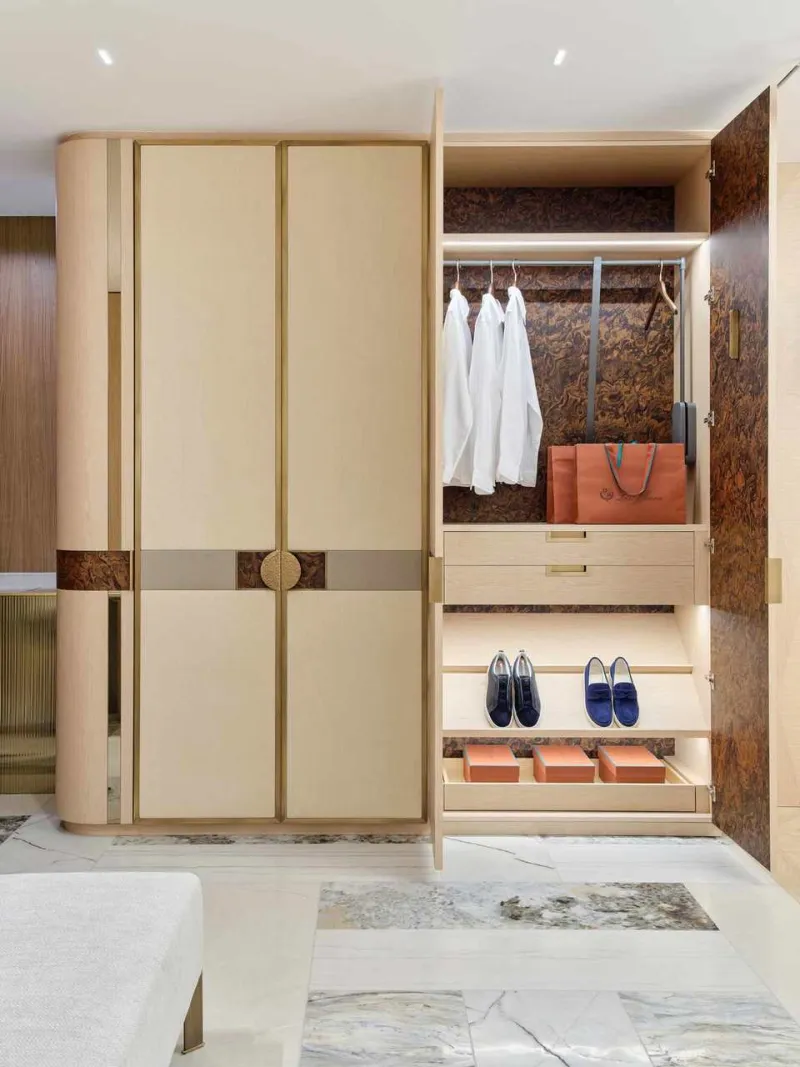
A hybrid usually works best. Keep lower drawers and hanging space behind solid doors, then use open shelving above or at one end of the run. Glass doors are a middle ground if you want display without constant dusting, though they can look busy if the shelves are packed. In older Bacup properties, avoid putting open shelves tight against a cold external wall; leave a small air gap so air can move behind the books.
The weight question nobody wants to ignore
Books are heavy. A shelf of hardbacks can add up quickly, and a fitted wardrobe is not automatically designed to carry that load. Make sure the shelving specification suits the job: thicker boards, proper shelf supports and uprights at sensible intervals. As a rule of thumb, shelf spans should be shorter for heavy books than for linen or shoes. Fixings need to go into studs, masonry or a properly designed carcass, not just plasterboard.
If you are using a local installer, say plainly that the shelves are for books. It is better to over-engineer a book wall than to watch a shelf bow after six months. Keep the heaviest volumes low down and reserve the top shelves for lighter paperbacks, ornaments or boxes.
Dust, damp and Lancashire air
Books dislike damp more than almost anything else. In older terraces and stone-built homes, condensation and poor ventilation can leave pages wavy and spines spotted. Fitted storage can help by keeping books off cold walls, but it can also trap moisture if airflow is blocked. Aim for a design that lets air circulate: avoid sealing books tightly into a damp corner, and do not push the wardrobe hard against a wall that has a history of damp.
Dust is easier to manage. Closed doors reduce it, and a soft brush attachment on the vacuum keeps open shelves in order. If you have hay fever or simply hate dusting, glass doors or a mix of closed and open storage will save you time. In a reading nook, a small shelf for current books is fine; the archive can live behind a door.
Building a library wall around the wardrobe
A full wall of fitted storage can combine hanging, drawers and books without looking like a jumble. One workable layout is a wardrobe at one end, open shelving in the middle, and a shallow reading nook or window seat at the other. The nook needs good light, a comfortable seat and a shelf within arm’s reach. It does not need to be deep; 45cm to 50cm is often enough for a built-in bench with storage underneath.
If you want a library wall, think about sightlines. A tall run of shelves around a doorway can feel enclosing, so break it up with a lower section or a mirror. In a small box room, a single column of open shelves beside the wardrobe may be enough. In a larger bedroom, a full wall can become the room’s best feature.
Details that make book storage live well
Adjustable shelving is worth asking for, because book sizes change. Integrated LED lighting helps you read titles without a overhead glare, and a socket near the reading nook is useful for a lamp or charger. Bookends matter more than people expect, especially on open shelves. Magazine files keep periodicals tidy, and a couple of closed drawers hide the clutter that books inevitably create.
Finally, leave some empty shelf space. A book collection that fills every gap from day one will be overflowing by next Christmas. Fitted storage works best when it has room to breathe, just like the room around it.