Steady Hands, Gentle Doors: Fitted Wardrobes That Grow Old With You in Bacup
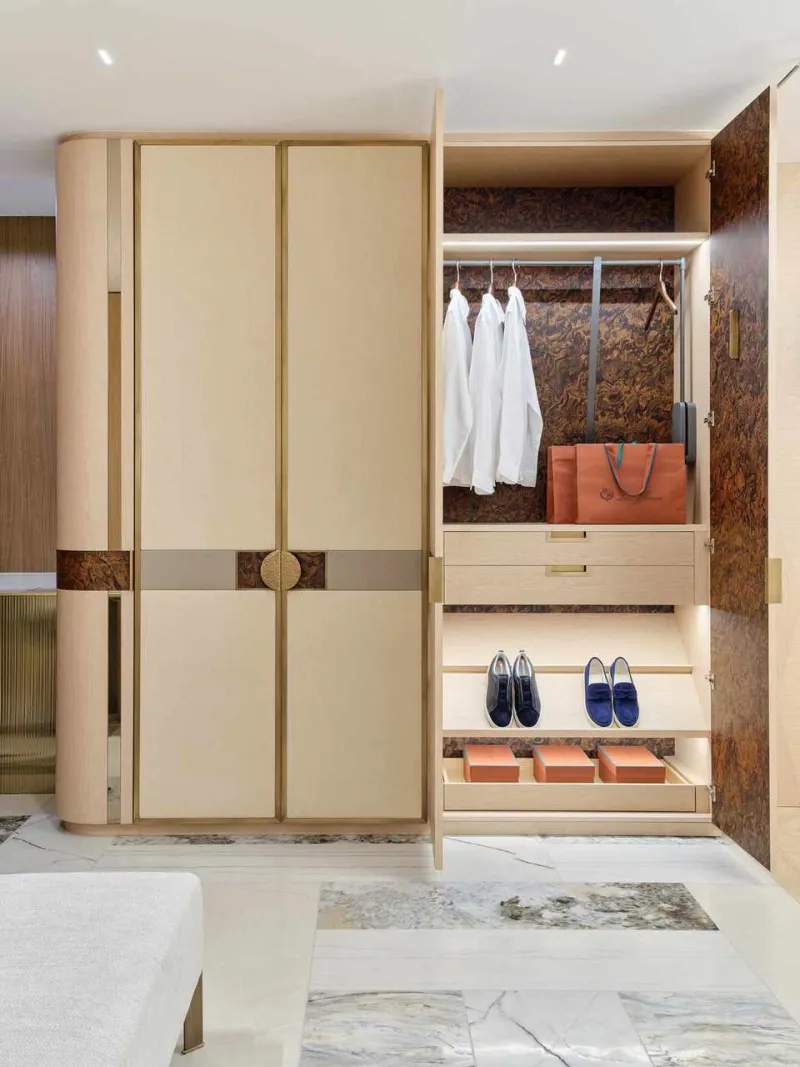
Photo: Faura Ltd, CC BY-SA 4.0, via Wikimedia Commons
Walk into most Bacup bedrooms with fitted storage and you'll see the same arrangement: a rail up near the ceiling, a stack of drawers down by the skirting, and a row of small round knobs. It looks tidy. It also assumes you'll always be able to stretch overhead, crouch to the floor and pinch a 20mm knob between finger and thumb. That's a fair assumption at thirty-five. It's a shakier one at seventy.
Nobody wants to plan a bedroom around the idea of getting older. But there's a wide middle ground between ignoring the question entirely and handing your fitter a hospital catalogue. A few well-chosen details — most of which cost very little at the planning stage — keep a wardrobe pleasant to use for decades. Here's where they tend to pay off.
Start with a reach map, not a floor plan
Before anyone talks about carcasses or door styles, sketch out three horizontal bands on the wardrobe elevation.
The middle band, roughly between hip and eye height, is where the everyday things should live. Shirts, trousers, the jumpers you actually wear, daily medication, the folder of paperwork you keep promising to sort. This is the zone that stays easy to reach regardless of what happens to your shoulders or your balance.
Above that is the stretch zone — seasonal bedding, suitcases, the Christmas box. Fine, as long as you can get to it occasionally with a step stool and a steady hand. Below knee height is the bend zone, and it's the one people underestimate. Deep drawers at floor level are a genuine nuisance once hips and knees get less cooperative, and they're usually filled with things you don't need anyway.
A good fitted design pushes as much daily storage as possible into the middle band and treats the top and bottom as overflow. In a small Bacup terrace bedroom, where you can't simply add more wardrobe, that rebalancing often frees up more usable space than people expect.
Rails that come down to meet you
One of the most useful changes in accessible bedroom storage is also one of the least visible: a pull-down rail. It's a hanging section on a sprung or levered mechanism that lets you bring the whole rail to chest height, load it, and push it back up. No reaching, no stretching, no wobbling on tiptoe.
These work best in a full-height hanging bay rather than crammed under a shelf, and they need proper fixing into the carcass — this isn't a job for a bracket from the bargain bin. Ask your fitter to demonstrate the action with a full load of coats, not an empty rail. And test the return: a rail that needs two hands and a firm shove is no improvement on a fixed one.
If a pull-down unit feels like overkill, a simple compromise is to drop the main rail by 100mm and accept a shorter hanging drop. Most shirts and jackets don't need the full height, and the shorter reach makes a real difference.
The grip question
Handles are where fitted wardrobes quietly fail. Small round knobs look neat in a showroom and become impossible in a household where arthritis, reduced hand strength or a tremor is part of daily life. Push-to-open catches are worse — they demand a firm, accurate push in exactly the right spot.
The practical answer is a handle you can hook fingers behind or push with the side of a hand. Slim D-handles, C-bars and simple lever handles all work well, and none of them look remotely medical. Pick a finish that reads as a design choice rather than an adaptation: brushed brass, matt black, satin nickel.
While you're at it, think about drawer runners. A well-made soft-close runner glides with a light pull and finishes the job itself. A cheap roller runner needs a yank and slams shut. If there's one place to spend a little extra in a fitted bedroom, it's here.
Doors that glide rather than swing
Hinged doors are lovely in a generous room. In a Bacup semi with a tight landing or a bedroom where the bed sits close to the wardrobe, they're a hazard waiting to happen — especially for anyone using a walking stick or frame.
Sliding doors solve the swing problem and are easier to operate with limited reach, provided the track is decent. Cheap tracks rumble, jump and need a firm tug. Better ones run on smooth bottom rollers with a top guide and a soft-close at each end. Bi-fold doors can also work well in narrow spaces, but only with quality hinges; a sagging bi-fold is harder to manage than a plain hinged door.
Whichever you choose, leave a clear walking route. A metre of unobstructed floor in front of the wardrobe makes dressing easier for everyone and essential for some.
Light, contrast and tired eyes
Eyesight changes slowly and almost invisibly. A dark wardrobe interior with dark clothes and no lighting becomes a guessing game.
A motion-activated LED strip under the top shelf is inexpensive and transformative. Choose a warm white around 3000K rather than a stark blue-white, and make sure the strip is diffused so it doesn't glare. For shelves, a light-coloured interior — pale oak effect, soft grey, off-white — makes everything inside easier to distinguish.
Contrast helps too. A slim contrasting edge band on shelves and drawer fronts gives the eye something to track, and it's a detail that looks deliberate rather than clinical. If anyone in the house has low vision, consider tactile labels on drawers, or simple colour-coded boxes for bedding and paperwork.
Keep the floor honest
Thresholds, rucked carpet and clutter are the real trip hazards in a bedroom, not the wardrobe itself. If you're having fitted storage installed, use the moment to check the flooring in front of it is level and firmly fixed. Avoid plinths that jut out beyond the door line, and don't let the wardrobe run so deep that it narrows the route to the window.
Can it look like a bedroom, not a care home?
Yes, and fairly easily. Accessibility is mostly about dimensions and mechanisms, not about grab rails and wipe-clean surfaces. Slim profiles, handleless push-latch drawers (only where hands are strong), shaker or slab doors in a colour you'd have chosen anyway — none of that shouts 'adapted'. The giveaway is usually clutter control: a place for everything, at a height that suits the person using it.
Adapt the built-ins or start again?
If your existing wardrobes are sound — solid carcass, straight doors, decent fixings — there's a lot you can change without ripping anything out. Swap the rail for a pull-down unit. Replace knobs with D-handles. Add interior lighting. Change a bank of low drawers for a taller stack at waist height. That's generally far cheaper than replacement and much less disruptive in an older Bacup home where walls are never quite square.
Replacement starts to make more sense when the layout itself is the problem: rails set too high with no room to lower them, a reach-in cupboard too deep to get at, doors that foul the bed. In those cases, a rework of the internals — keeping the outer frame — is often the sensible middle option.
A quick checklist before you sign off
Ask yourself: can I reach the everyday items without stretching or bending? Do the handles work with a loose grip? Do the doors open without blocking the route across the room? Is there light inside? Would I notice the adaptations if I walked in cold?
If the answer to the last one is no, you've probably got the balance right.